
Solutions › AI & Intelligent Automation
AI & Intelligent Automation
Start with a focused pilot, then scale what works.
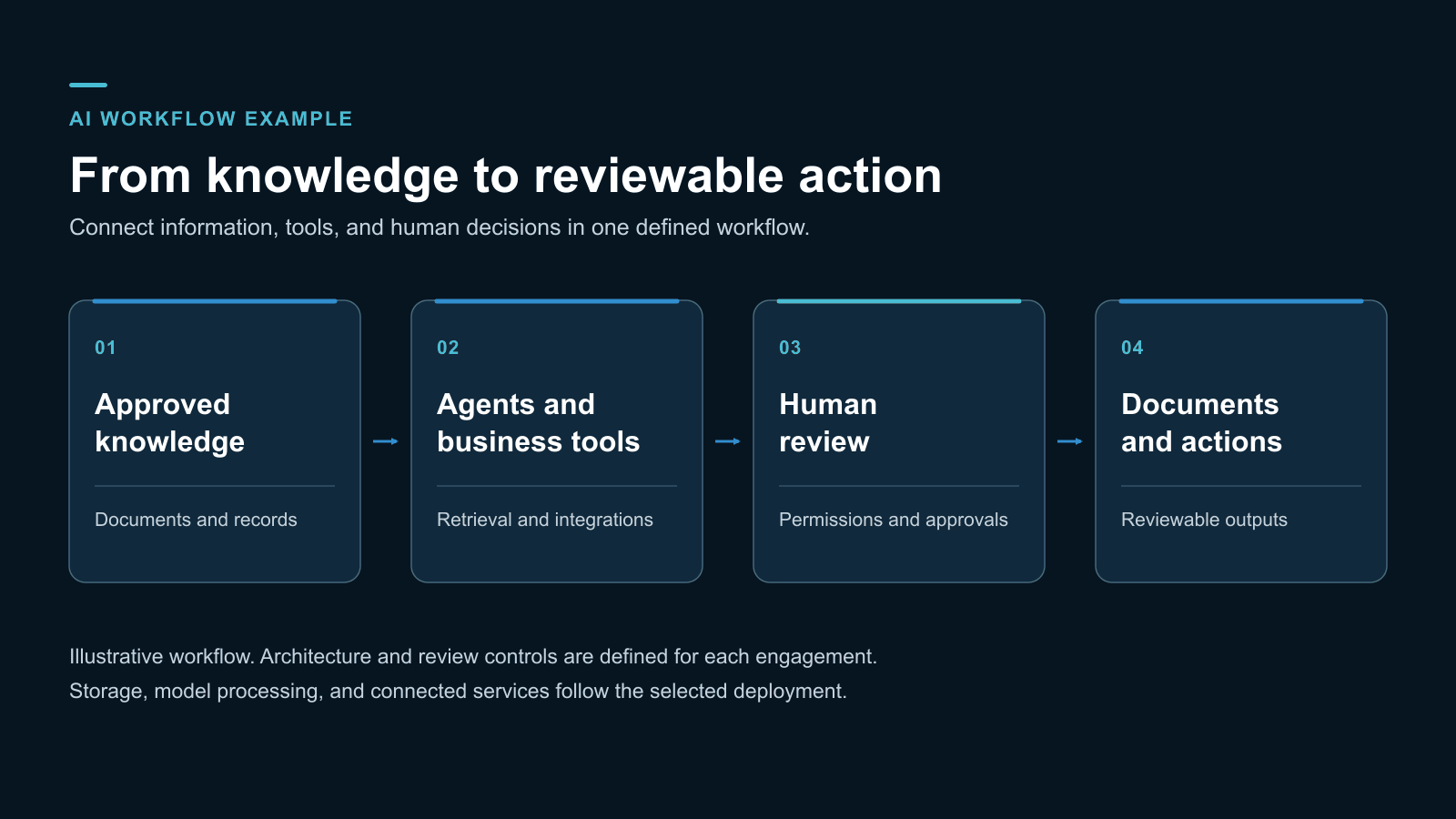
LTS Group Inc. designs and integrates artificial intelligence (AI) assistants, knowledge systems, and intelligent workflows. Bring research, documents, email, tasks, and application actions into a coordinated process with defined permissions, human review, and operating responsibilities.
Our technical foundation includes coordinated AI agents, search across your approved documents, locally stored knowledge indexes, connections to your existing tools, and structured document generation. We connect these capabilities with the enterprise systems and information your organization already uses.
AI capabilities connected to your environment
- Coordinated AI agents
Coordinate specialist AI agents for research, drafting, tool use, and review, coordinated in Python. Define how tasks are assigned, how context moves between agents, and when work returns to a person. Clear roles and handoffs make a multi-step workflow easier to inspect, evaluate, and maintain. - Enterprise knowledge search
Prepare approved documents and information sources so people can search them by meaning and ask questions in plain language. Each answer draws on the relevant source material, and the search index can be kept on your own systems. Source references and provenance records help reviewers trace information to its origin and judge whether it supports the output. - Tools, documents, email, and tasks
Connect authorized tools through application programming interfaces (APIs) and selected connectors. Bring document access, email information, task records, and application actions into the same workflow. Define permissions, approval points, data exchanges, error handling, and audit records for the actions the integration can perform. - Proposals, RFI/RFP responses, and structured Word output
Develop workflows for requests for information (RFIs), requests for proposals (RFPs), technical proposals, and reports. Work from approved requirements, source content, and templates. Organize drafting by section, apply reviewer passes, and produce structured Microsoft Word documents with the intended headings and template layout. Keep source references, open questions, and approvals connected to the document review. - Review, approval, and traceability
Build human checkpoints into drafting, tool use, and actions that affect business records or commitments. Configure provenance, structured outputs, and audit logging so the responsible team can review sources, decisions, actions, and unresolved items. Evaluate unsupported responses and failure cases alongside successful examples; agree what needs further review before an output is used.
Turn information and repeated steps into coordinated work
Teams spend time finding the right source, moving information between tools, preparing documents, and checking outputs. LTS brings those activities into a defined workflow: identify the task, retrieve approved information, perform the agreed steps, and present work for review.
This can support an internal knowledge assistant, a proposal-development workflow, document and research coordination, or automation across business applications. The design establishes the source material, action permissions, review points, and evidence needed to assess the result.
From a focused pilot to a supported deployment
A pilot tests a defined workflow with approved information, representative tasks, and agreed success criteria. Typical evaluation covers retrieval relevance, document structure, source support, permissions, tool behavior, and user review.
A deployment scope then addresses the selected models and infrastructure, access administration, connected systems, data handling, operating documentation, training, and support ownership. Pilot findings inform the deployment decision and the work needed to prepare the environment. Expansion follows validation of the specific workflow and its operating needs.
Make storage and model processing explicit
The architecture identifies where documents, search indexes, model requests, retrieved excerpts, and logs are processed and stored. Local knowledge storage can be combined with hosted model services; those requests may transmit selected information to the provider.
We document local and hosted components separately, along with approved data flows, access boundaries, retention requirements, and review responsibilities. Fully local processing depends on the selected model, tools, and infrastructure.
How the five stages fit
- Plan + Design: define the workflow, source information, agent roles, permissions, data flows, and evaluation criteria.
- Build + Integrate: configure the knowledge layer, agent coordination, document workflows, and approved tool connections.
- Commission + Turn Over: evaluate representative and failure cases, verify review controls, document limitations, and train users.
- Standardize + Scale: reuse validated templates, agent patterns, connectors, and evaluation checks across approved workflows.
- Operate + Support: maintain sources, integrations, permissions, evaluation records, and the agreed operating and support process.
Useful outputs
Depending on the scope, deliverables can include:
- A use-case assessment, workflow design, and data-flow/permission map.
- An agent-role and coordination design with defined human checkpoints.
- A configured knowledge index and source/provenance approach.
- Approved tool integrations and structured document templates.
- A prototype or pilot, evaluation results, and unresolved-actions record.
- Deployment documentation, user training, and operating/support arrangements.
The statement of work identifies the applicable deliverables, acceptance criteria, and pilot or deployment boundary.
Questions about intelligent automation
- Can you connect AI with the tools we already use?
Yes. We assess available APIs, connectors, permissions, and data access, then define the integration around your tools and workflow. The selected connections and permitted actions are documented in scope. - Can the solution run entirely within our environment?
Deployment options depend on the selected models, tools, infrastructure, and task. We document storage, indexing, inference, integrations, and logging separately so the processing boundary is clear. - How do you check the quality of generated work?
We agree representative tasks and acceptance criteria, check source support and document structure, review tool behavior, and record limitations and open issues. Human review and approval are designed around the intended use and the consequences of an action.
Bring your AI workflow into focus
Tell us what your team needs to find, prepare, connect, or act on. We can help define the knowledge, tools, integration work, and review process needed to move the idea forward.